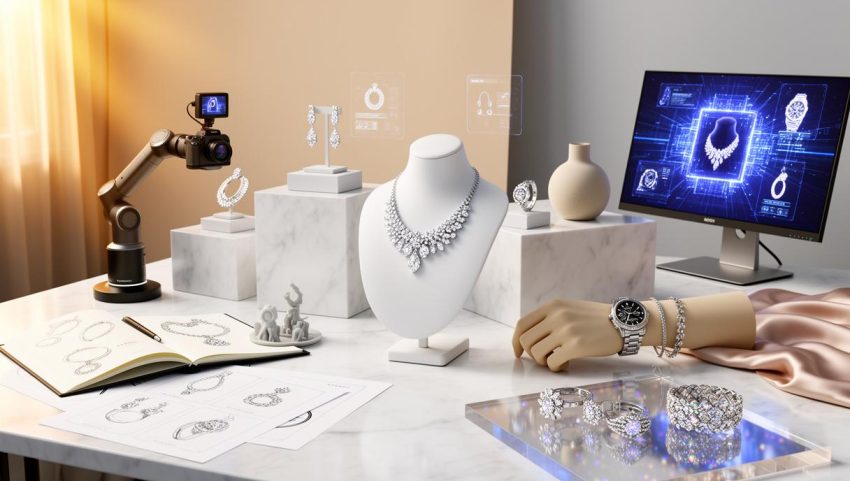
Jewellery is unforgiving in front of a lens. Highly reflective metals, tiny prongs, pavé textures, and prismatic stones conspire to reveal every lighting flaw and post-production shortcut. Traditional studios solve this with time, talent, and expensive setups—yet still struggle to keep pace with e‑commerce demands. Enter AI jewellery product photography: a new, scalable way to produce consistent, high‑fidelity visuals that preserve diamond fire, metal sheen, and micro-detail while accelerating creative workflows. For artisans, designers, and luxury retailers, it’s a shift from waiting on shoots to launching with confidence—faster, at scale, and in stunning resolution.
Why AI Changes Jewellery Photography: Precision, Consistency, and Real‑World Realism
Photographing jewellery blends science and craft. Metals mirror the environment. Gemstones refract and reflect in complex ways. Even minor color casts can misrepresent white gold, platinum, or rose alloys. Conventional techniques require meticulous lighting control, multiple exposures, polarisation, and extensive retouching. While that can produce premium results, it’s costly and slow to repeat across hundreds of SKUs, colorways, and seasonal campaigns. AI jewellery product photography rethinks the process by modelling materials, light, and context computationally—so outcomes are predictable, repeatable, and brand‑consistent.
Material-aware AI helps interpret CAD files, sketches, or reference images into photorealistic outputs that respect the physical character of jewellery. Diamonds maintain brilliance without blowing out highlights. Sapphire, emerald, and ruby hues stay accurate across lighting scenarios. Micro‑pavé maintains crisp grain without mushy halos. For metals, adaptive tone mapping preserves the difference between polished and brushed finishes, while reflections remain believable rather than artificially flattened. This level of fidelity is not just cosmetic; it’s critical to setting customer expectations and reducing returns.
Consistency is another breakthrough. Whether creating clean packshots on white or black, 45‑degree beauty angles, or hero lifestyle scenes, AI can standardise camera height, lens choice, composition, and color space across entire collections. Templates capture brand rules—from shadow density to background falloff—so every ring, chain, and pendant aligns visually, no matter when it’s produced. When rapid SKU expansion or varianting is on the roadmap, generating coordinated imagery across sizes, metals, and gemstones becomes a process, not a pain point.
Finally, speed unlocks creative freedom. Because AI can simulate multiple studio setups and environments instantly, product teams can explore more looks without reshoots: clean e‑commerce views, editorial campaigns, and even on‑model angles that would normally require casting, logistics, and complex lighting. With 2K and 4K outputs available, the same assets support storefronts, marketplaces, paid social, and even print without sacrificing sharpness. For brands balancing premium quality and agility, this convergence of accuracy, throughput, and repeatability is game‑changing.
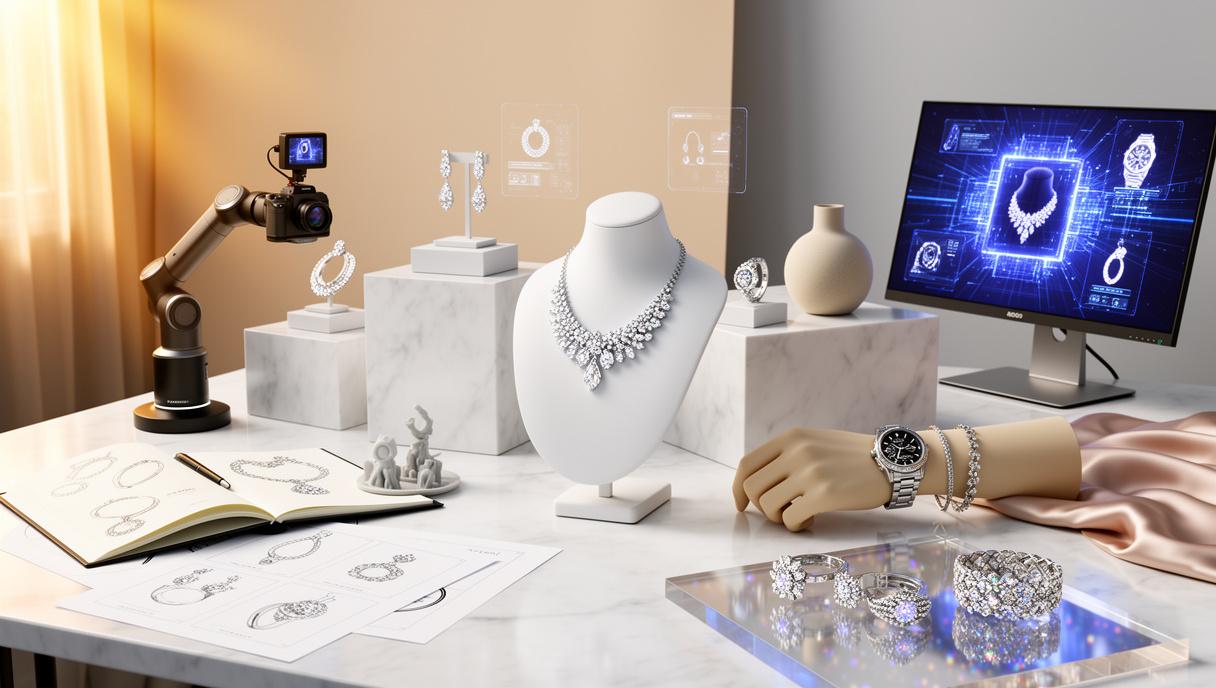
From Sketch or CAD to Storefront: A Practical AI Workflow for Launch‑Ready Visuals
A modern AI‑powered workflow starts earlier than a traditional shoot. Designers often begin with sketches or CAD, and that upstream data can drive imagery long before physical samples exist. After importing a CAD file, AI interprets geometry and applies material logic—mapping white gold versus platinum, assigning stone cuts, and reading surface finishes. If only a phone photo exists, background cleanup and perspective correction can still generate a robust starting point. A drag‑and‑drop studio interface then becomes the creative cockpit: choose angles, set lighting, dial shadows, and add subtle reflections that convey luxury without distracting glare.
From there, templates standardise essential e‑commerce views: front, side, angled beauty, and clasp or fastening details. In a single session, teams can produce the canonical packshot set plus campaign‑ready variants—on colored backdrops, textured surfaces, or soft lifestyle vignettes that fit the brand’s art direction. For editorial needs, AI creates believable context: a ring on a hand with natural skin texture and realistic finger articulation; a necklace draped on a collarbone with correct chain fall; earrings positioned symmetrically with accurate ear‑to‑shoulder proportions. Because the system understands form and scale, it avoids uncanny distortions that break trust.
Color management is critical, especially for gemstones. AI workflows support reference‑driven tone matching, so what customers see aligns with the actual product’s hue and saturation under common lighting conditions. White balance and exposure rules can be locked globally to stop drift across batches. Retouching becomes surgical rather than heroic: remove a casting artifact on a CAD‑derived prototype image, smooth a micro‑scratch, or tone down a hotspot—always non‑destructively, always under a consistent style profile.
When it’s time to publish, 2K and 4K exports in web‑friendly formats keep storefronts light and crisp. Variants (metals, stones, sizes) can be generated in bulk, each inheriting the same camera, crop, and shadow logic for frictionless merchandising. Explore AI jewellery product photography to see how streamlined studios are translating concept to commerce with fewer handoffs, fewer reshoots, and a single source of truth from design through launch.
Proven Use Cases, ROI Wins, and Best Practices for Premium Results
Scaling content no longer means spending more per image. A boutique fine‑jewellery label launching 50 SKUs can generate core packshots, angled views, and a compact lifestyle set over a few days instead of weeks, compressing time‑to‑market without compromising finish. A watchmaker can iterate on bezel, dial, and strap combinations virtually, test campaign looks, and lock a visual identity early—then roll out coherent imagery across regions and seasons. Custom designers can pre‑sell bespoke pieces using AI‑rendered visuals faithful to gemstone and metal specs, validating demand before committing to fabrication.
Returns drop when visuals are honest. That’s why realism matters: accurate metal color, believable gem scintillation, true‑to‑scale proportions, and detail clarity that withstands zoom. AI solutions excel here because they can embed brand rules—lens choice, background behavior, and shadow density—into every asset. Marketing teams benefit from rapid A/B testing of backgrounds or angles to see which combinations lift click‑through and conversion. Operations benefit from fewer bottlenecks, since a virtual studio runs on creative direction and assets rather than physical availability, weather, or scheduling.
To get the most from AI jewellery product photography, a few best practices help ensure premium output. First, feed the system good inputs: clean CAD with accurate material notes; well‑lit reference images that represent the intended finish; or high‑res phone shots taken with diffuse light to reduce harsh hotspots. Second, define brand templates early—color space, white balance, shadows, and framing—so every new image inherits consistent rules. Third, document stone and metal taxonomy with precision (e.g., F‑G VS1 round brilliant; 18k rose gold, brushed, 20% roughness) to preserve fidelity across scenarios. Fourth, create a simple QA checklist: verify prong visibility, chain fall, engraving legibility, and clasp detail before publishing.
Compliance and transparency also matter. If a product visual is derived from a prototype or CAD, clearly label it as a rendering where required, especially for marketplaces with strict image policies. Match marketplace guidelines—neutral backgrounds, minimum pixel dimensions, margin constraints—while maintaining your own style for owned channels. For print, produce 4K or higher and keep layered masters for future adjustments. Finally, embrace iteration: use analytics to refine angle choices, background tones, and crop ratios. The platform’s speed turns experimentation into a strategic advantage, helping artisans, designers, and luxury houses present pieces at their luminous best while keeping production agile and cost‑efficient.

Reykjavík marine-meteorologist currently stationed in Samoa. Freya covers cyclonic weather patterns, Polynesian tattoo culture, and low-code app tutorials. She plays ukulele under banyan trees and documents coral fluorescence with a waterproof drone.